Golden Touch Craps
Hello from Golden Touch Craps/Blackjack:
Welcome once again to the new Golden Touch e-Newsletter, keeping you in touch with all our latest news and offerings.
|
NEW DVD
|
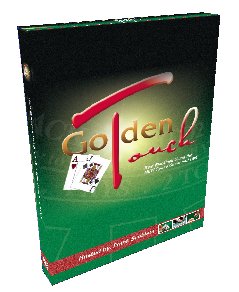
Whether you've read the Golden Touch Blackjack Revolution! book, or taken a Golden Touch Blackjack Course, or if you've just been waiting and wondering what it's all about, this is the DVD you have to get. Watch Frank Scoblete himself in the comfort of your own home as he shows you in this DVD all about Speed Count, the easiest way to beat the casino in blackjack. Only $99.95, plus shipping, until the end of November. For more information and ordering, visit our web site: http://www.goldentouchcraps.com/GTCBJDVD.shtml.

|
Frank Scoblete's World Casino Championships 2009 (WCC '09) |
In Fabulous Las Vegas! August 14, 15 and 16 in 2009. Special $25,000 and $50,000 dice rolls. Tournaments in Craps, Blackjack, Pai Gow Poker, Baccarat and Slots! Also 10 great classes by Frank Scoblete, Henry Tamburin, Jerry "Stickman" and other GTC celebrities. Prizes and plaques for the winners and runners-up in the tournaments. Great lunches and a very special full-service awards banquet too! Special Advantage Play mid-week pre-WCC '09 courses available for blackjack, craps tuneups with Frank Scoblete and Dominator and advantage-play slot machines (extra course fees apply). Only $699 but a special discount of $100 for GTC newsletter readers - you pay just $599 but you must sign-up before November 30th. Click here to sign-up online at the reduced $599 rate. For more information, visit our web site: http://www.goldentouchcraps.com/wcc_2009.shtml.
New Articles Since Last Issue...
In this issue of the GTC e-newsletter, we're including new articles directly in the e-mail! This means you don't have to click links to GTC web site to read these articles. The new articles are spread out throughout the newsletter, so read to see new content from Frank Scoblete, Bill Burton, Jerry 'Stickman', and Henry Tamburin.
Stickman's stance... advantage gambling from the front line!
'Stickman' is a lead GTC and GTB instructor, and a proven veteran of dice control. Read his latest article, Having Fun Playing Slots.
Having Fun Playing Slots
By Jerry "Stickman"
Note: While the author prefers not playing casino games where he cannot get an edge, he realizes that many casino gamers do not want to take the time to develop advantage player skills. He also realizes that many advantage players visit the casino with spouses, family and friends who just want to relax and have some fun. This article is written for these casino players.
Ah, slot machines with their lights flashing and melodies playing - row after row of these ubiquitous machines crammed in every imaginable space on the casino floor. They are by far the most popular game in casinos today. And why not? At what other casino game can a gambler simply drop in a few coins and have the possibility of winning thousands - or even millions - of dollars?
Today's wide selection of slot machines is a far cry from the machines of a few decades ago. What began as a relatively simple and purely mechanical machine has been transformed over time into a highly sophisticated device. With the new technologies come new variations. With the dizzying array of new variations come decisions for the slot-playing gambler.
They range from single-line slots that take from one to three quarters up to $100 tokens to multi-line, multi-coin machines in penny to quarter denominations. Some machines are linked to others in the casino and offer a progressive jackpot that climbs until someone hits it. But the ultimate in a jumbo jackpot are slots that are linked to others throughout the area offering some lucky player a multi-million dollar windfall should the right symbols appear.
Choices, choices, choices.
To help the novice - and not-so-novice - slot player, some advice in choosing and methods of playing slot machines follows. If you are like the average gambler, you head for the casino with a certain stake that you hope will offer you the means to become rich. At minimum you would like your bankroll to provide you with a few hours of play each day you are at the casino.
Money management and slot machine selection are the keys to enjoyable slot playing sessions. Of the two, money management is by far the most important.
For an enjoyable slot playing experience, you must only play with money you can afford to lose. All slot machines have a house edge built in, so don't dump money you need for the mortgage payment or a heart operation into the game hoping for a windfall.
This requires discipline. Here is a good method for keeping within your bankroll and maximizing your chances of coming home with a profit.
First and foremost, do not use the cash machine at the casino as your bankroll. The money you use for gambling should be totally separate from any other money you may have. It is far too easy to lose track of your financial situation if you take your gambling session money from an ATM.
Instead, before you leave for the casino, divide your available gambling money into session stakes. If you are going to be at the casino for two days and you plan on playing one session in the morning, one in the late afternoon and one after dinner, divide your trip bankroll into six even amounts and put each in a separate envelope. For example, if you have $1,200 available to gamble on a trip, put $200 into each of six envelopes. Label each envelope with the information about the session you are planning to play with the money in it.
When you arrive in your room, put all these envelopes in the room safe. When you are ready to play the slots, take only the envelope for the session you are about to play and leave the rest of the envelopes in the safe. That way you will not be tempted to dip into it should the current session not go as well as you would like.
While playing the slot machine, it is important to pace yourself. Though you are not necessarily putting a lot of money into the slot for each spin, it is easy to accumulate a lot of spins - and therefore money invested - in a short period of time. Assume you are playing a 25¢ machine with three coins played per spin. By playing at a fairly leisurely pace of one spin every 5 seconds, you will run $9 through the machine every minute. This translates to $540 per hour. That is a lot of money for a 25¢ machine. Pacing your play will help your money last longer through the inevitable losing streaks.
In order to have a fun time playing the slots and increase your chances of hitting a jackpot, you want to be able to play for a decent length of time each session. This can only be done by playing a machine with a proper denomination.
If you only have a $200 session bankroll and would like to play for a couple of hours, you should probably play a quarter or smaller denomination machine. As shown in the calculations above, you can easily run over $500 through a 25¢ 3-coin machine in an hour. Playing a 3-coin dollar machine moves the figure to over $2,000 per hour. The chances of having a losing streak that will quickly wipe out your session bankroll are dramatically increased on the dollar machine. The jackpot amounts are higher, but the chances of a quick wipe-out are much greater. Play within your bankroll.
Finally, make sure you select the proper type of slot for your style of play and bankroll. If you really want to have fun by playing a couple of hours per session, you will want to avoid the "Mega" jackpot machines. The gigantic jackpots have to be paid for somehow. That somehow is a much lower payback on the non-jackpot spins. Your money will simply not last near as long on these machines as on lower jackpot machines.
Does that mean you should not play the Mega Jackpot machines? Definitely not, just keep in mind that your session stake will be eaten up much quicker that on lesser jackpot machines. Just remember to play maximum coin-in if you are going to play these machines. Nothing would be for sad than to hit the jackpot-winning combination of symbols and not have the required coins played to win it.
If you are going to play a machine that adds winning combinations with more coins played, always play maximum coins.
May all wins be swift and large and your losses slow and tiny.
Jerry "Stickman" is an expert in craps, blackjack, video poker and advantage slot machine play. He is a regular contributor to top gaming magazines. The "Stickman" is also a certified instructor for Golden Touch Craps and Golden Touch Blackjack. For information on slot machines that can give the player an advantage, get Specific Slot Machines That Give the Players the Edge! By Jerry "Stickman" - Mathematically proven advantages over the house on some slots! Foreword by Frank Scoblete. $129 plus $6 handling or $99 for a download version.
For more information visit www.goldentouchcraps.com or www.goldentouchblackjack.com or call 1-886-738-3423. You can contact Jerry "Stickman" at stickman@goldentouchcraps.com.
"So easy, a 12 year-old can learn Speed Count in 15 minutes!"
As said by Frank Scoblete, about the Golden Touch Blackjack advantage play method
Do you have to be a Math Whiz to win at blackjack? NO! Speed Count, the easiest advantage-play blackjack method will have you beating the casinos in only a few minutes of practice. It really is that easy... if you ever play blackjack in the casinos, then you are crazy to not learn the Speed Count card counting method. Add blackjack to your game-plan to beat the casinos, for those times when your craps throwing arm needs a break! And Speed Count is mathematically proven to get you an edge over the casino.
We've arranged a special GTC discount on the full Speed Count training software bundles from DeepNet Technologies, inventors of the method as taught by Frank Scoblete in his book, Golden Touch Blackjack Revolution!. Get $10 off either the Speed Count or Professional Bundle. Nothing is shipped to you: you get to download the full software version immediately after you purchase and use it right away. Here is the list of features in each bundle:
Program/Feature |
||
| Blackjack Counter software |
|
|
| Blackjack Expert software |
|
|
| Speed Count System |
|
|
| Golden Touch Blackjack Revolution! e-book |
|
|
| Blackjack Count Master e-Book |
|
|
| High-Low Count System |
|
|
| Blackjack Audit |
|
|
|
Purchase a bundle: (choose a platform) |
Price: $55 (normally $65) |
Price: $85 (normally $95) |
|
Installation program, trial version: |
||

Join the ranks of savvy blackjack players who get the edge over the casino, without the need to be a mathematical genious and months of training! These software bundles contain absolutely everything you need to become an expert card counter, with a focused training regime including pass/fail exercises so you know when you are ready to hit the casinos.
Other software discounts from the only software provider GTC endorses, DeepNet Technologies:
Smart Craps Professional for Windows (www.SmartCraps.com)
- Normally $129.95, yours for only $95. Click here to order online (immediate online download, not shipped)
- Find out what your fellow GTC students are raving about . Prove whether your dice control skill is working, and what edge you can get.
- Includes the Smart Craps simulator, Roll Recorder for Windows and Palm OS, dice set optimizer, advanced betting module, and much more.
Poker Drill Master for Windows (www.PokerDrillMaster.com)
- Normally $59.95, yours for only $49.95. Click here to order online (immediate online download, not shipped)
- Learn to correctly determine poker pot odds, and make the best decisions at every betting opportunity.
- Use the incredibly fast and powerful poker calculator that tells you the winning probabilities and odds for any combination of known and unknown hands and/or board (just like on TV!).
- Use the powerful poker system editor that lets you select from supplied pre-flop decision methodologies by popular authors and experts, as well as edit or create your own systems.
- View the Outs table to quickly find single card outs probabilities and pot odds with one or two cards to go.
Bill Burton on poker
Bill Burton, well known poker player, author and GTC instructor, has a wealth of great articles that will hone your game. In our latest issue, Bill writes about 10 Tips for Playing No Limit Tournaments.
10 Tips for Playing No Limit Tournaments
Several weeks ago I was hired to organize and run a poker tournament for a corporate sales event. The company thought it would be a great way for their employees to bond while enjoying a different form of entertainment. Some of the attendees had never played in a live tournament before so they asked me to speak with the group and give them a few tips before the tournament started. Last month I covered the etiquette tips I gave the players before the tournament. This month I share some of strategy tips I gave them. Whether you are new to no limit poker tournaments or more experienced you may find these 10 tips helpful in getting you to the final table.
Strategy Tips
The biggest mistake a player makes is playing too many hands. A winning player is one who is very selective about the hands they play. You also need to be aware of your position. A hand that can be played from late position in an unraised pot may not be able to be played from early position. You need a stronger hand to play from early position because you have more players acting after you who may raise or re-raise the pot.
Don't over value suited cards. The biggest mistake that most novice players make is playing any two suited cards from any position. You will be dealt two suited cards about 23 percent of the time. You will only make a flush about 5.77. Simply put for every time you play two suited cards you will only make your flush about once in 16 tries. If you play low suited cards you still have to worry about a bigger flush beating you.
Another similar mistake that players make is putting too much value on small pocket pairs. When you have a small pocket pair you want to get into the hand as cheaply as possible and hope you flop a set. Too many players will call raises or go all in with small pocket pairs. The best you can hope for is a hand will essentially be a coin flip. This is not the type of hand you want to risk your tournament life on.
Use the "fit or fold" criteria for deciding to play after the flop. If the flop does not fit your hand you should fold if there is a bet in front of you. A flop fits your hand by improving it or by giving you a good draw to improve your hand or simply if your hand beats the board as it is.
Raise the same amount every time. Most pro players will bet three to four times the big blind when they raise. This makes it hard for anyone to pick up on the strength of their hand. When they bet the same ach time you don't know if they are raising with pocket aces or 27 off suit.
If the pot is raised before it is you turn to act you will have to call the original bet and the raise. This is known as cold calling. Unless you have a very powerful hand you should not cold call any raises. You need a stronger hand to call a raise than you do to initiate one. Why waste valuable chips on a speculative hand?
Avoid confrontations for all of your chips. Many unskilled players have two moves during a no limit tournament. They either fold their hand or they go all in. This strategy may work fine for awhile and win you a few pots but it will never win you the top prize.
Bluffing is a very valuable weapon to have in your poker arsenal but you should make sure you use it correctly and don't over use it. Never try to bluff more than two players. There will usually be someone who wants to "Keep you honest." Make sure your bluff is believable.
A winning player is the one that initiates the action. If you are first to act rather than checking, bet. If there is a bet before you consider raising rather than calling. You should be well aware of the complete arsenal at your disposal including check-raising, slow playing, semi-bluffing and how to gain a free card if necessary.
Pay attention even when you are not involved in a hand. You should always be aware of the number of players involved in the hand. Was there a raise before the flop? If so who raised and what type of hands has that person been playing? Look at the cards the other players turn over at the showdown. This is valuable information that could help you win the pot in the future.
Until next time, remember:
"Luck comes and goes...Knowledge Stays Forever!"
*****************************************************
About the writer.
Bill Burton is the Casino Gambling Guide and columnist for the Internet portal About.com located at: www.casinogambling.about.com He is the author of "1000 Best Casino Gambling Secrets" and "Get the Edge at Low Limit Texas Hold'em" available online at www.billburton.com. He an instructor for Golden Touch Craps: www.thecrapsclub.com
Free Three Month Membership to Blackjack Insider
We've arranged this special offer for all of our GTC newsletter subscribers. Get a full three month membership to the Blackjack Insider e-newsletter, a monthly publication of new articles best the gaming industry's best experts. This offer let's you read all articles, even members-only articles from previous issues in their archives going back to 2001!
Click here for your free 3-month BJI membership
Henry Tamburin on blackjack...
Henry Tamburin, Lead Golden Touch Blackjack Instructor and well-known blackjack author, provides a number of great articles to improve your game. His latest article talks about Splitting Aces and 8s.
SPLITTING ACES & 8's
By Henry Tamburin
Always split aces and eights. That is one of the golden rules for blackjack players but not according to a friend of mine. He insists that splitting eights against a dealer upcard of 9, 10, or ace is crazy because you are probably going to lose anyway, so why double your loss by splitting?
Although my friend's logic appears to make sense it is flawed. Here's why.
When you split in blackjack, you must bet more. That is a fact. The strategy of pair splitting, then, only makes sense if you end up either winning more or losing less in the long run vs. standing or hitting.
Losing less is often a hard concept for blackjack players to grasp. For example, you can expect to be dealt a 12 through 17 hand about 43 percent of the time you play blackjack. No matter what strategy you follow, the dealer will, on average, win more hands than the player will (with only one exception- a 17 vs. a dealer's upcard of 6). Thus the best a player can do in a losing situation is to use a strategy that will allow him to lose less in the long haul.
This is in fact the situation with a pair of eights against a dealer 9, 10, or ace. If you hit the eights (or 16), you will lose on average about $52 for every $100 bet. That is quite a hefty loss, but not to be expected because you a big underdog when you hold a 16 against a dealer's strong upcard of 9, 10 or ace. However when you pair split, you break up you 16, double your bet, and play two hands of 8. A computer analysis of this situation shows you will lose about $43 per $100 bet when you split 8's. This is still a losing proposition from the player's perspective. But notice by splitting you've won just enough slpit hands to reduce your overall loss $9 per hundred dollars wagered. You've reduced your loss by pair splitting the 8's which is why it's the better strategy than hitting or standing.
To be sure sometimes when you split a pair of 8's against say a dealer 10 you will lose both split hands. You might even hear some comments from the dealer or fellow players about why you should have stood or hit. Forget about them. Just remember that in the long run which means after you are dealt many pairs of 8's you will wind up losing less than if you stood or hit. Follow the basic strategy and always split 8's no matter what the dealer shows.
Thankfully my friend always splits aces. You would think that every blackjack player would automatically split aces. But recently I observed a young player pass on splitting aces because "she was afraid to bet more on the hand". I even offered to make the bet for her at no risk (if the bet lost she owed me nothing). But it was like talking to a wall. She insisted on hitting the pair of aces and drew two tens and broke. She was mumbling incoherently when she left the table knowing full well that if she had taken my offer she would have had two hands of 21 (by the way, I was card counting and the count was positive indicating she had a good chance of drawing tens to her aces.)
It use to be standard casino policy that when you split aces you would get one and only one draw card to each split ace. Sometimes the player would draw another ace and was stuck with a hand of 12. Nowadays many casinos allow players the opportunity to resplit aces. In the above example the player could split his third ace and play three hands. Resplitting aces is a favorable player rule that adds about 0.06% in the player's favor. It doesn't look like much of an edge but every bit helps so always resplit aces!
Follow the golden rule and always split eights and aces no matter what the dealer upcard happens to be. Splitting aces will result in significant gains for the player. Splitting 8's for the most part is a defensive play that will cut down on your losses. But keep in mind you will lose your fair share of hands when you split 8's, but if you were to hit or stand, you would on average be losing more money. It's the smart play to make when you play blackjack.
"
Black Chip" Specials for Dice Control and Blackjack Seminars in 2009 Click here for upcoming courses...As a preferred client of Golden Touch Craps, we are offering a
VERY SPECIAL BLACK CHIP DISCOUNT for our 2009 seminars in blackjack and craps. You must call and give us a deposit to reserve your seat by December 1st 2008 to get these special discounts. You won't get a lower price than these for our 2009 courses. Note: multiple offers cannot be combined.If you have been thinking about enrolling in our seminars, now is the time! Learn the most comprehensive way to control the dice and beat the game of craps. At our Speed Count seminar you will learn the easiest way to beat the game of blackjack consistently. Check out our websites
www.GoldenTouchCraps.com and www.GoldenTouchBlackjack.com for a complete description on the course structure. All you have to do is give us a call and either pay for the seminar in full or give us a 50% deposit to reserve your seat.To sign up, Call TOLL FREE: 1-866-SET-DICE or 1-886-738-3423
Scoblete keeps pumping out the wisdom...
New gambling articles by the prolific Frank Scoblete himself. Visit his page to catch his frequently updated thoughts and tips on all things casino-gambling. Informative, and always entertaining... don't miss his weekly musings!
Be Happy with What You've Got
By Frank Scoblete
Last year a great New York Yankee Hall of Fame baseball player Phil Rizzuto died. The papers were filled with stories about how such a short guy - Rizzuto was "just" 5'6" - had overcome his height disadvantage to achieve such big things. He was an all-star, an MVP, won ten pennants and eight World Series during his 13 years with the Yankees. He was described as a "winner" in baseball and in life.
On Rizzuto's plaque at the Yankee Stadium Memorial Park it reads: "A man's size is measured by his heart."
That got me to thinking. Was being 5'6" a disadvantage in baseball or in life? I am 5'7" and I never felt that I was short. I never made comments about being short or jokes about myself as some short people do. Indeed, it never occurred to me to do those things.
In my mind I was the right height. People who were taller than I were tall; people who were shorter than I were short. I played basketball; I played baseball. I played with and against the best players in New York City. I never felt as if I had to overcome anything. I just played to the best of my ability.
Intellectually I now realize that I am on the short part of the height continuum but in my head I still have that "I am the right size and everyone else is either tall or short."
Casino players can learn a lot from Phil Rizzuto. You play the game with what you've got and in casino terms that specifically means with the bankroll you've got for actually playing such games. You can't wish and hope to have more money to play with because that makes you feel bad about yourself. What has the size of your bankroll got to do with anything? You are who you are. There's nothing to be ashamed of.
The casinos, obviously, are skillfully designed to reward those players who bet (and lose) large sums of money. But it does not follow that the player who loses large sums of money is a better player than someone who loses small sums of money - how good a player you are is not determined by the size of your bets but by the strategies and decisions you make.
I've seen many of those high rolling players using strategies that were so awful you wanted to shake them by the collar and say, "You are throwing your money away!" And I have seen mere five dollar players engaging in tight contests with the casinos. Of the two types of players, which is to be respected? The answer is obvious.
If a high roller doesn't use basic strategy at blackjack; if that roller makes high house edge bets at craps; if he plays low payback slots and video poker machines; if he uses his "intuition" to guess what trends are about to appear or disappear (the deadly "see a horn, bet a horn" strategy), this person is large all right - he is a large fool.
The small wagering player who knows how to play the games the right way - using all the tools the casino allows to reduce the house edge to its minimum - is really a large player indeed. It is not the size of the bankroll that counts; it is the intelligence in which it is used.
Often in the casino atmosphere the red-chip player wishes he were a green-chip player and the green-chip player wishes he were a black-chip player and the black-chip player wishes he were a purple-chip player and the purple-chip player wishes he were an orange-chip player (and on it goes) - that is a caste system that must be discarded in order to play the games properly. Wishing you were someone else is not going to make you a better player. Learning the proper playing strategies will.
So let the casinos put people in castes, that's their business; to get people to bet more, play longer, in order to "impress" the casino comp raters; but your business as a savvy player is to play perfectly with the money you have and ignore all the other players playing higher denominations and not worry about comps.
Phil Rizzuto played the game the best he could with all the ability he could play with. That made him a Hall of Famer. That made him a winner. Height be damned!
If you want to enter the casino Hall of Fame than you must play with what you've got and you must play the perfect strategies. There is no shortage of good betting strategies that follow the math of the games; strategies that give you a real chance to bring home the casinos' money.
Phil Rizzuto's object was to win games and that should be your object too. You are your own standard of performance; no one else is. Be happy with what you've got and play accordingly.